Rapid Value Stream Mapping
Quickly visualize and measure end-to-end flow to reveal the most critical focal point for performance improvement

Steve Pereira
What Is Rapid Value Stream Mapping?
Similar to traditional Value Stream Mapping, Rapid Value Stream Mapping is a variant from Flow Engineering that simplifies the map artifact and blends the strengths of Event Storming and Metrics-Based Process Mapping to quickly create a 'good enough' map of flow and data in 2 hours or less.
Why Do Rapid Value Stream Mapping?
It's often difficult to get buy-in or time for extensive mapping, so Rapid Value Stream Mapping is tailored for common circumstances and intended to fit within timeboxes teams already have allocated for less productive efforts.
Rapid Value Stream Mapping was created within digital product development and IT, so it is digital native (the first maps were actually created in Google Sheets - which is not recommended!) and focused on mapping that can accommodate remote workers using video conferencing and realtime collaborative whiteboards. Rather than traditional Value Stream Mapping which focused on physical manufacturing, trucks, and warehouses, it focuses on the invisible efforts of knowledge work and tech, as a way of creating some clarity in highly uncertain and adaptive environments.
The mapping allows for the same benefits provided by Value Stream Mapping: Shared visibility of work, data to support decision-making, and focus on a key constraint or bottleneck.
Combined with the other maps of Flow Engineering, it allows for a quick and complete execution of improvement discovery from initial need or goal, all the way to actionable, owned and measured next steps, by creating visibility and understanding of the current flow of work.
It's common that Rapid Value Stream Mapping creates an immediate 20% reduction in lead time just by creating visibility and focus on easily-removed waste. Combined with improvement efforts and automation, it's common to see 60-80% reduction of end-to-end lead time for large value streams like projects, product development, and incident response.
The same practice can be used on any flow of activities, such as:
- Customer or new hire onboarding
- Product development
- Partner integrations
- Business acquisitions
- Incident response
- Sales process
- Marketing campaign execution
- Event planning
How to do Rapid Value Stream Mapping?
The process consists of five distinct stages.
1. Stream Selection
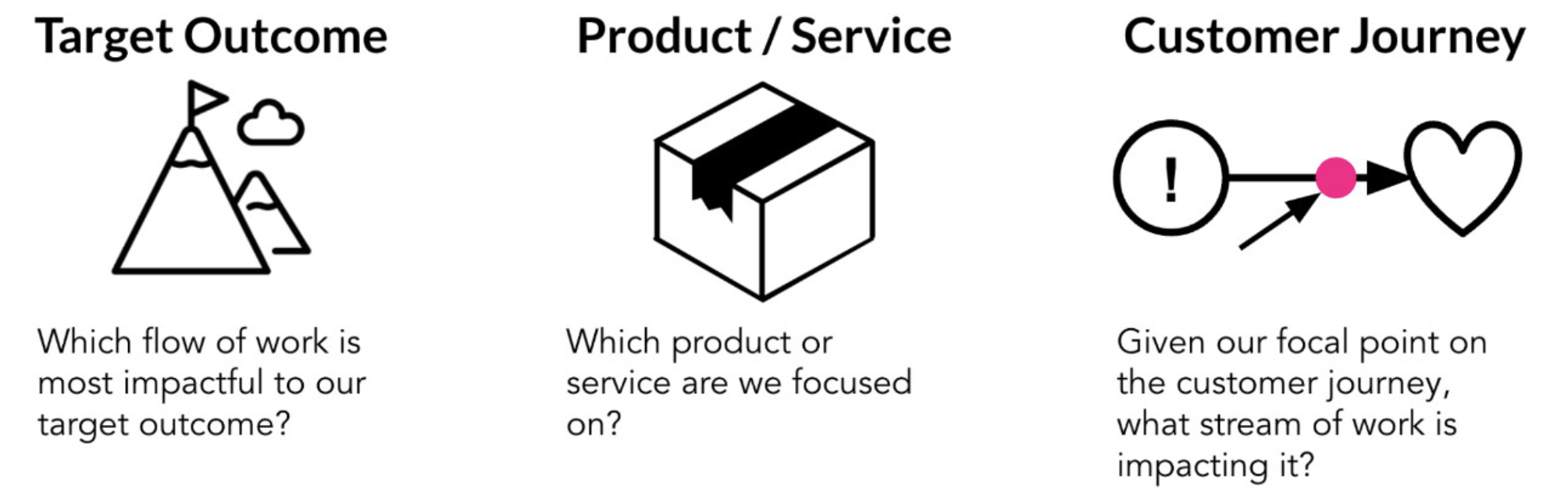
You cannot map everything. This step focuses the team on the specific sequence of work most relevant to your Target Outcome - what you aim to achieve.
Facilitation tips:
- Anchor to the Customer: Ask, "Who is the customer receiving the value defined in our workflow, in service of our target outcome?" e.g. If you want to reduce incident response time, then you would use your incident response process flow as the stream in question.
- Define Boundaries: Explicitly agree on the start and end points of the stream.
- Limit Scope: If the stream is too large (e.g., "Idea to Cash"), slice it. Focus on the segment most likely to contain the bottleneck preventing the target outcome.
- 5 Rs: Paula Thrasher highlighted 5 factors to ensure selection of an effective value stream. It should be a flow of work that is Recent (happened in the recent past), Real (a flow that creates actual business value), Reach (it should extend all the way to customers experiencing the output), Road Tested (it should be something established and operational), and Representative (it should be a flow that is typical for the group involved).
2. Lay Out Activities
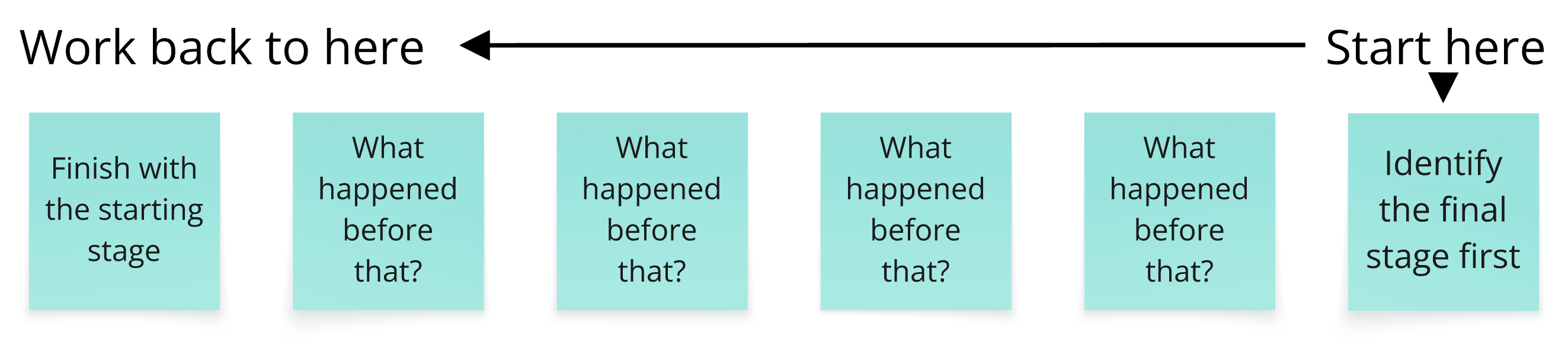
This visualizes the work. The goal is to capture the reality of what actually happens, not what should happen. Write out a short title for each activity in the flow on individual post-its, and lay them out in a complete, end-to-end representation of the flow of work.

Facilitation tips:
- Work Backward: Start from the customer/end value and ask, "What happens immediately before this?" This prevents missed branches and "happy path" bias.
- Use Verbs: Ensure every sticky note describes an action (e.g., "Review Code," "Deploy Artifact").
- Keep it Rough: Discourage perfectionism. If a debate arises about a specific step order, note it as a variation and move on.
3. Add Timing
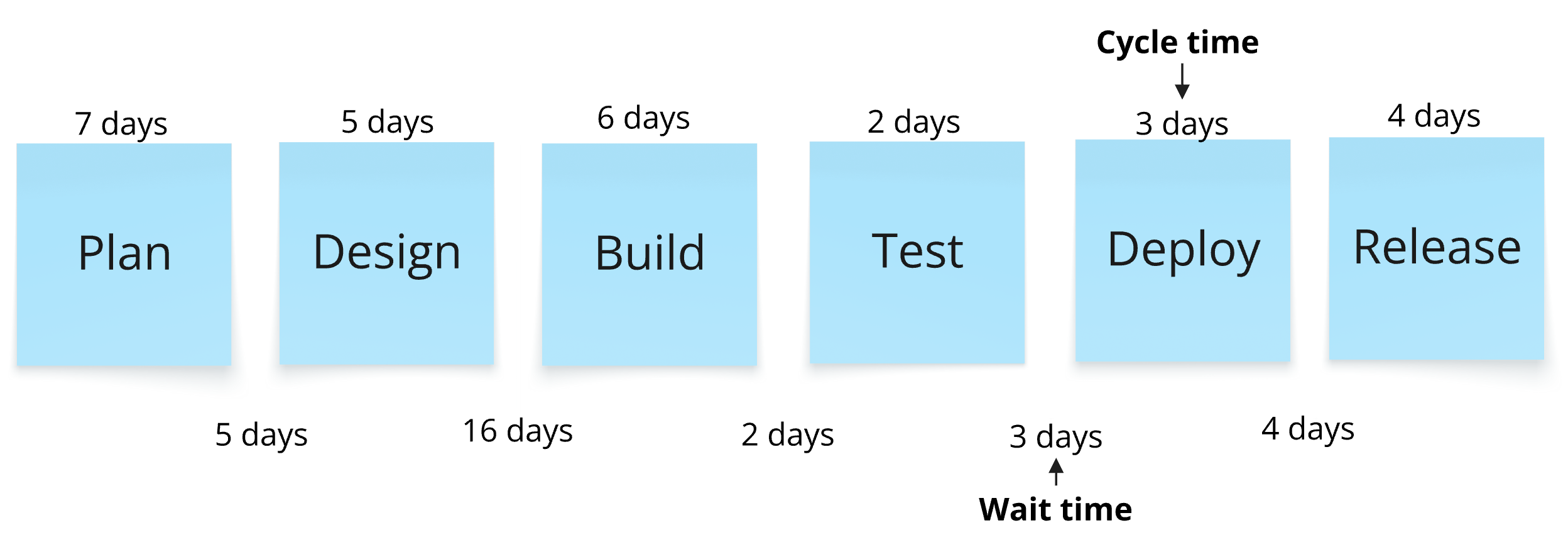
This adds the dimension of flow to the map, revealing where time is actually spent versus where value is created. Capture Two Key Metrics: Focus primarily on Cycle Time (the start-to-finish time for each activity) and Wait Time (queue time/delays/waiting).
Facilitation tips:
- Use Ranges if you hit friction: Teams often freeze when asked for exact numbers. Ask for best case / worst case to establish the range of "it depends" but press for what happens "most often".
- Calculate Lead Time: Sum the times to show the total duration, highlighting the efficiency gap (Process Time / Total Lead Time).
4. Add Other Relevant Data
Time isn't the only cost. This step layers on additional context needed to understand the friction in the system. If you're tight on time, you can fill this in later.
- Information Flow: Capture flows of data and information between roles, teams, tools, and systems. Consider approvals, reviews, consultations, and feedback loops.
- Quality Metrics: Ask about % Complete & Accurate (%C/A)—"How often does this step receive work that is usable without clarification or fix?"
- Tools & Artifacts: Note where the work happens (e.g., Jira, Slack, Excel) to highlight context switching and data exchange.
- Frustration Levels: Use simple indicators (like red dots or frowns) to mark steps that burn out the team, even if they are fast.
5. Highlight Constraint
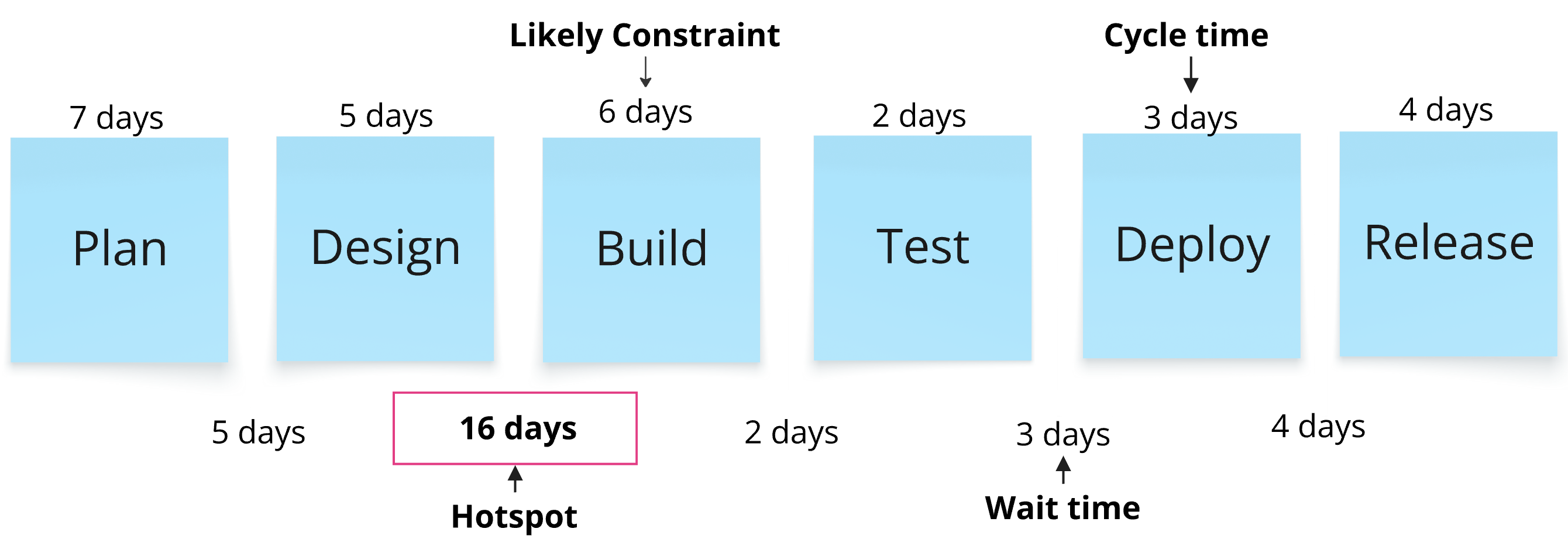
The ultimate goal of the map is to find the primary bottleneck. This focus prevents efforts that make conditions worse by overloading an already constrained activity, and avoids distraction and excess work in progress.
Facilitation tips:
- Focus: Push the team to agree on the single biggest factor limiting the flow right now.
- Aim for narrow: Look to highlight one delay or stage. We can always expand or zoom in, but biting off too much is a risk to making progress.
- Set expectations: If we don't focus, we likely achieve nothing. Make it clear that we're intentionally setting other opportunities aside in favor of rapid progress and results. Once we get initial results we can tackle more and bigger challenges.
To act on what you discover, either dig deeper into the constraint causes with Dependency Mapping, redesign the value stream with Future State Value Stream Mapping, or jump ahead to a Flow Roadmap.
Look at Rapid Value Stream Mapping

Links we love
Check out these great links which can help you dive a little deeper into running the Rapid Value Stream Mapping practice with your team, customers or stakeholders.